

SailPoint shipped an MCP server that turns natural-language prompts into enterprise access requests — and while the concept is solid, the real story is in the architectural decisions you need to make before you connect an AI agent to your IGA platform.
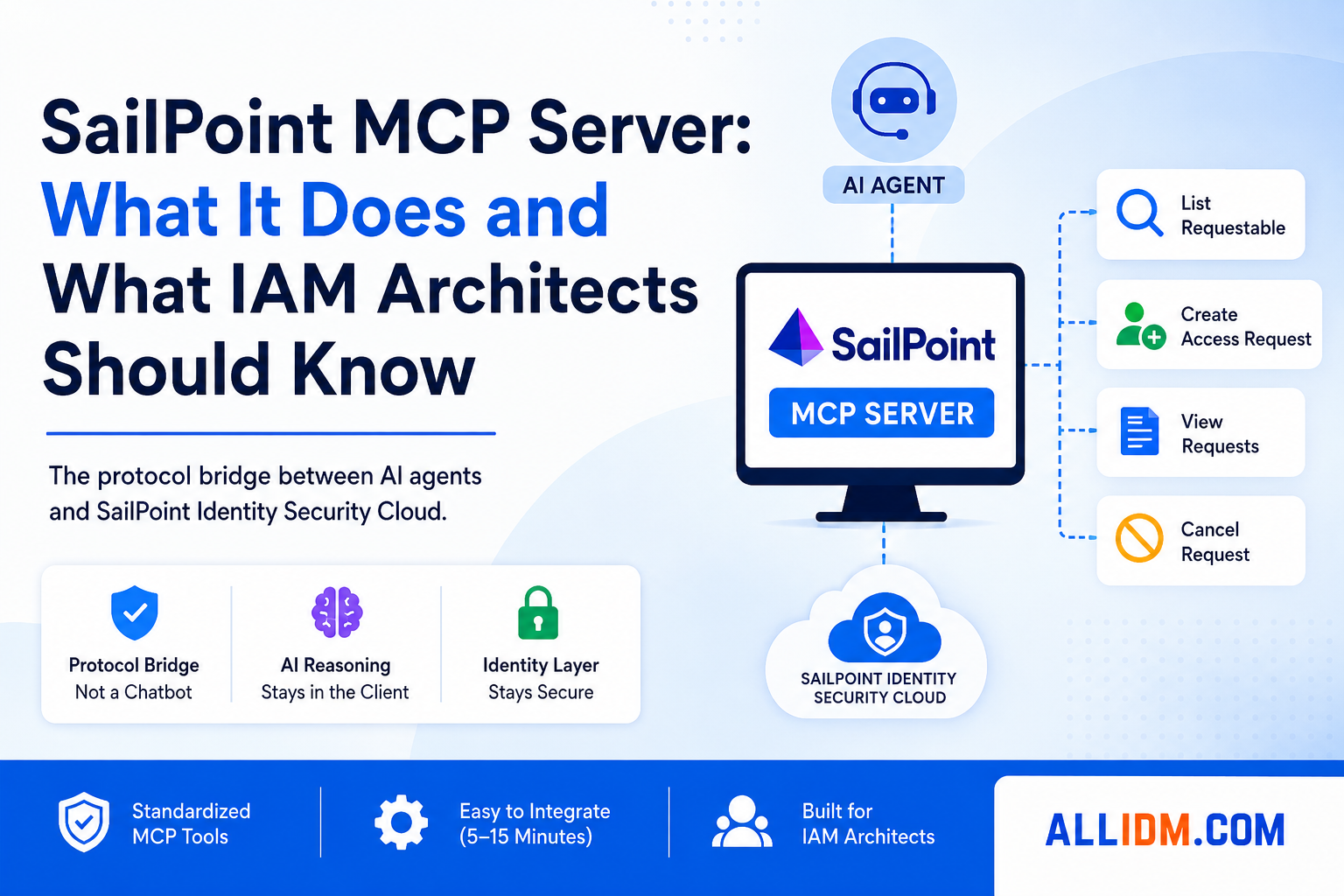
Generally available since September 2025, the SailPoint Model Context Protocol (MCP) Server connects any MCP-compatible AI agent directly to SailPoint Identity Security Cloud (ISC). It exposes four standardized tools that let AI applications search for requestable access, create and cancel access requests, and query request status — all through the same ISC approval workflows and audit trails your team already manages.
This isn’t a SailPoint-branded chatbot. It’s a protocol bridge. The AI reasoning stays in the client (Claude, Copilot, n8n, LangChain — your choice). SailPoint owns the identity layer.
What the MCP Server actually does
The server exposes four tools that map directly to the ISC access request lifecycle:
- list-requestable — Searches roles, entitlements, and access profiles using natural language. Lets an AI surface what a user can request before acting.
- create-access-request — Submits an access request on behalf of the authenticated user. Triggers existing ISC approval flows and SoD checks.
- view-access-requests — Returns request status and history using the request ID.
- cancel-access-request — Cancels pending requests that are still in a cancellable state.
Every action creates an audit event in ISC. Requests submitted through the MCP server are tagged “Requested by AI on behalf of <identity>”, and cancellations are similarly labeled. Your audit trail doesn’t lose context when an AI agent acts on a user’s behalf.
The “Bring Your Own AI” model and what it means operationally
SailPoint made a deliberate architectural choice: the MCP server provides the interface, not the intelligence. The AI client handles natural language understanding, decision logic, and workflow orchestration. SailPoint handles identity enforcement. That separation matters for security teams — you can swap the AI layer without rebuilding your access governance controls.
Integration works with any platform supporting remote MCP connections and HTTP streaming. Validated options at GA include Claude Desktop (zero-code), n8n (visual workflow builder), LangChain (programmatic), Cursor, and voice agents. Setup is documented at 5–15 minutes — though community experience has varied, particularly around Personal Access Token scopes and sandbox vs. production environment configuration.
The gaps IAM architects need to plan around
The MCP server solves one specific problem: frictionless access request submission for the authenticated user. It doesn’t solve access visibility complexity, approval bottleneck transparency, or multi-user delegation — and community feedback has been direct about this. Key constraints to flag before you build:
- Single-identity scope — The MCP server operates on behalf of the token holder. An admin token doesn’t grant the ability to query or act on behalf of other users. Support team use cases require a different architecture.
- PAT scope ambiguity — Required Personal Access Token scopes for MCP operations aren’t explicitly documented yet. Plan for iteration during setup.
- Approval transparency unchanged — Requests submitted via the MCP server still flow through the same governance group approval chains. If approvers aren’t visible to requesters in your current ISC configuration, that gap persists through the MCP layer.
- No AI reasoning audit — The ISC audit log captures what was requested and by what method, not why the AI agent decided to request it. For regulated environments, supplement with client-side logging.
Key takeaways
- The SailPoint MCP server is production-ready infrastructure for agentic access requests — not a demo. If your org uses SailPoint ISC and is evaluating AI automation, this is the right integration surface.
- The “Bring Your Own AI” model is a feature, not a gap. It keeps your governance layer stable while the AI ecosystem evolves rapidly around it.
- Audit traceability is built in. AI-initiated requests are clearly labeled in ISC — that’s the baseline requirement for any enterprise deployment, and SailPoint got it right.
- Plan for the identity-scoping constraint early. Most enterprise AI agent use cases will need a service identity with appropriate delegation, not end-user PATs.
📌 Sources: SailPoint Developer Community & SailPoint Official Documentation