

Anthropic’s Claude Opus 4.7 isn’t just a smarter model — it’s the first version purpose-built for the kind of long-running, multi-tool agentic work that identity teams are now being asked to govern.
Released April 16, 2026, Claude Opus 4.7 is Anthropic’s most capable generally available model. For most use cases, the headline metrics are about coding and reasoning. For IAM and security architects, the story is different: this is the model that makes agentic workflows actually viable at enterprise scale — which means it’s now your problem to govern.
What’s new that matters for agentic identity
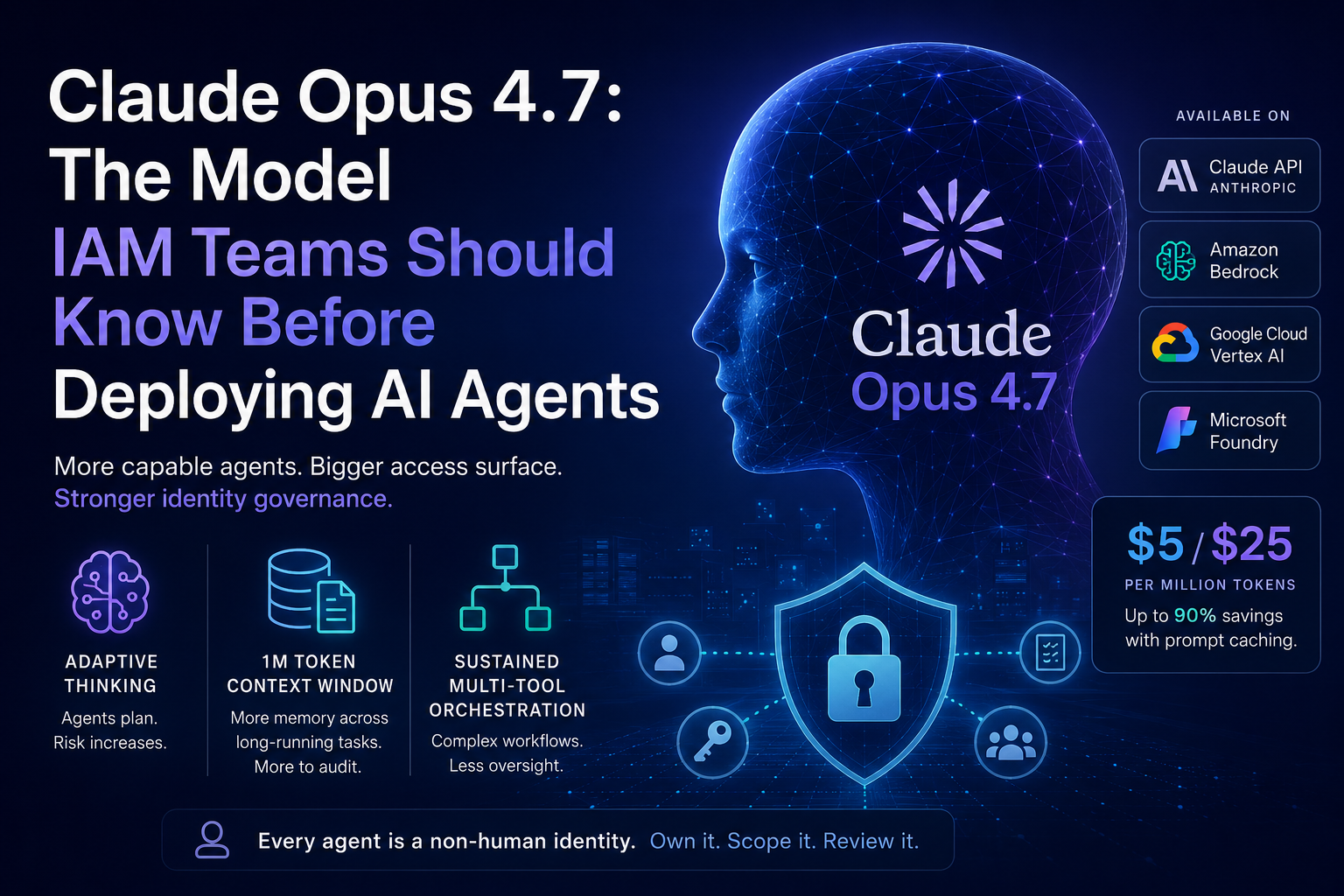
Three capabilities in Opus 4.7 directly affect how organizations need to think about AI agent governance:
- Adaptive thinking — The model automatically adjusts how much reasoning it applies based on task complexity. Agents don’t just execute; they plan. That changes the blast radius of a misconfigured identity.
- 1M token context window — Agents can now carry full session history, tool call logs, and cross-system context across long-running tasks. Memory that persists across a workflow is memory that needs to be audited.
- Sustained multi-tool orchestration — Opus 4.7 is designed to drive complex, multi-step pipelines with minimal human intervention. Less oversight in the loop means identity controls need to compensate.
The access surface just got bigger
Opus 4.7 is available natively on the Claude API and through Amazon Bedrock, Google Cloud Vertex AI, and Microsoft Foundry — the same platforms enterprises are already using to build production agent workflows. The model identifier is claude-opus-4-7. Pricing starts at $5 per million input tokens and $25 per million output tokens, with up to 90% savings via prompt caching.
Every new agentic deployment built on Opus 4.7 is a new non-human identity that needs an owner, scoped credentials, and an access review cadence. The model is more capable than its predecessors — which is exactly why the identity layer around it needs to be tighter, not looser.
📌 Source: Anthropic — Claude Opus 4.7