
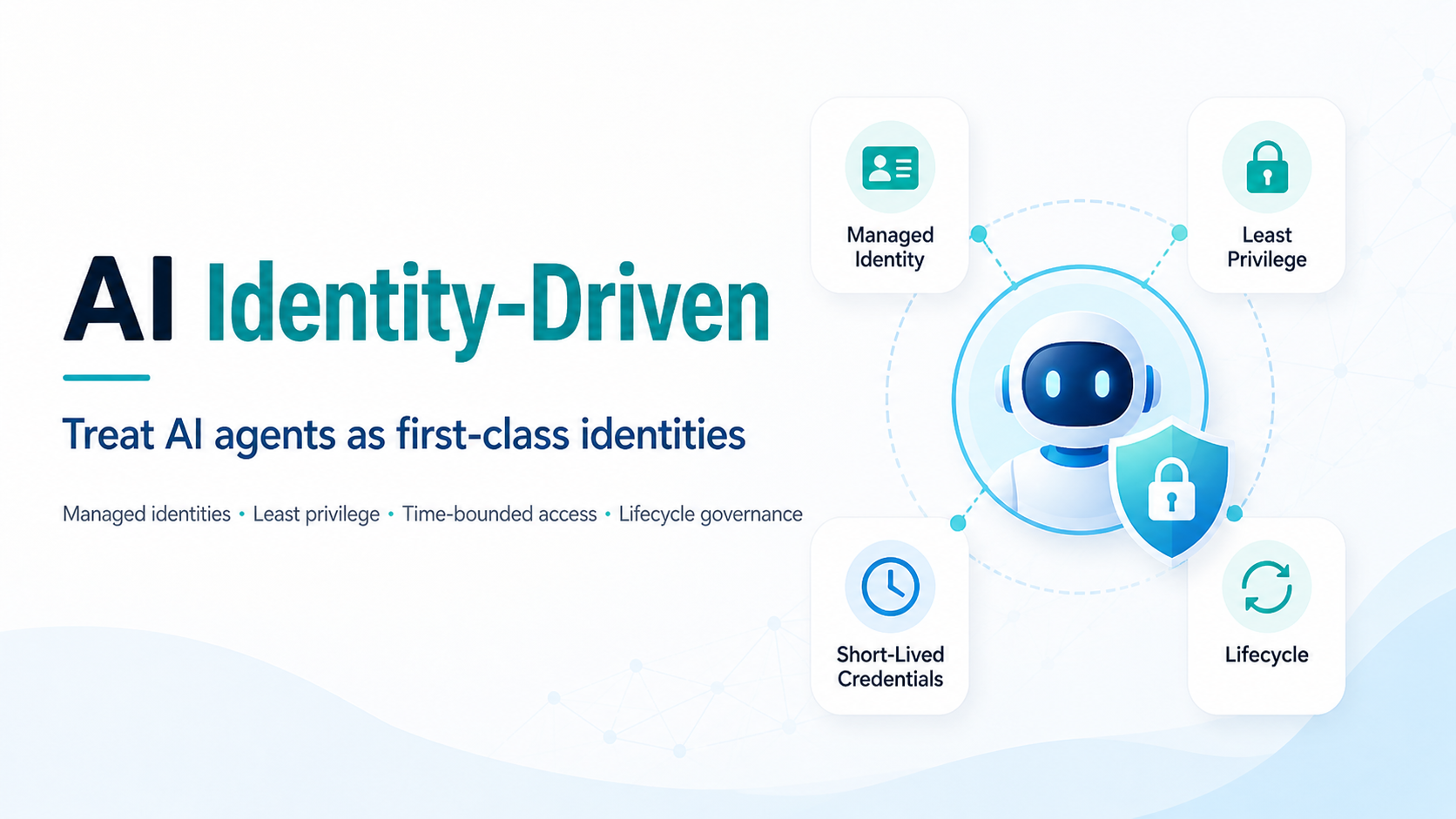

What does “AI Identity-Driven” mean?
An AI Identity-Driven organization extends identity governance beyond humans and traditional machine identities by treating AI agents as first-class identity principals. Each agent is assigned managed credentials, scoped entitlements, audit trails, ownership, and lifecycle controls so its actions can be governed, monitored, and revoked with the same rigor as any other enterprise identity.
It’s not about using AI to improve IAM. It’s about applying IAM discipline to AI — treating every agent, copilot, and automated workflow as an identity that must be provisioned, monitored, certified, and de-provisioned.
What is the risk?
The risk isn’t that AI agents are malicious — it’s that they’re capable. An over-permissioned agent will use every entitlement it has to complete its goal. Least privilege isn’t optional for AI; it’s the primary safety control.
The four pillars of an AI Identity-Driven strategy
| Pillar | Focus Area | Description |
|---|---|---|
| Pillar 01 | Managed AI Identities | Register every AI agent, orchestrator, copilot, sub-agent, and RPA bot as a managed identity in your IGA platform. |
| Pillar 02 | Least Privilege | Scope agent access to only the APIs, data sets, and actions required for the assigned task. |
| Pillar 03 | Time-Bounded Access | Use short-lived, task-scoped credentials that rotate automatically and expire when the work is complete. |
| Pillar 04 | Lifecycle Governance | Provision, certify, and de-provision AI agents using the same governance rigor applied to human identities. |
AI identity strategy: six steps
| Step | Action | Description |
|---|---|---|
| 01 | Inventory all AI agents | Audit every deployed agent, copilot, automation, and workflow tool. Map credentials, system access, and ownership. |
| 02 | Define an agent identity schema | Create a standard identity record with owner, purpose, data classification, access scope, token type, and expiry policy. |
| 03 | Extend your entitlement catalog | Tag entitlements as AI-accessible or not. Clearly define which permissions can be granted to agents. |
| 04 | Implement delegated authority controls | Allow agents to inherit only the permissions required for the delegated task, not the user’s full access. |
| 05 | Build an agent audit trail | Log what the agent accessed, changed, decided, and on whose behalf it acted. |
| 06 | Include agents in access certification | Review AI agent entitlements in certification campaigns. Auto-revoke access when reviews are missed. |
Maturity model
| Level | Maturity Stage | Description |
|---|---|---|
| Level 1 | Unaware | AI agents operate with unmanaged credentials, often shared service accounts. No inventory, lifecycle controls, or audit trail. |
| Level 2 | Reactive | Agents have dedicated credentials, but governance is informal. Access is broad, de-provisioning is manual, and logs are not actively monitored. |
| Level 3 | Managed | Agent identities are registered in IGA. Entitlements are scoped and tagged. Certifications include agents, with partially automated de-provisioning. |
| Level 4 | Optimized | Full lifecycle automation, JIT credentials, runtime delegated authority controls, reasoning traces, and continuous access monitoring with anomaly detection. |
The shift to AI-driven operations isn’t a future event — it’s already underway. Agents are being deployed faster than governance frameworks can keep up, and the gap between capability and control is where your risk lives.
An AI Identity-Driven strategy closes that gap by treating agents as what they actually are: autonomous principals that act on behalf of your organization, access your systems, and touch your data. The IAM controls you’ve built for humans and machines are the right foundation — they just need to be extended, not replaced.
The organizations that govern AI agent identity now will be the ones that scale AI confidently later. Start with the inventory. Build the schema. Extend the lifecycle. The governance discipline is the competitive advantage.